Two Brain Hemispheres are Better Than One
How would you like to learn historical events –in bullet points and chronologically arranged summary of historical events, or a story-telling discussion where the events are discussed in detail, the characters are well-described and backed-up by illustrations and short films?
What if schools, for the purpose of lessening school expenses, no longer hold field trips? Instead, a well-known speaker will be invited to talk and describe the place for the children to appreciate.
How would you like to learn the rules of a soccer game – buy or download a rulebook for you to memorize and watch Soccer101 demonstration from YouTube, or enroll yourself to a Soccer class, experience running around a field and learn from a coach’s instructions?
What if you were locked in a building equipped with high-security technology system. You are provided with all the gadgets you need to escape and you are familiar with all its names. Problem is… you don’t know how to use them.
How about Marvel Book, instead of Marvel Comics? Does it help you to get the gist of a movie or a book, before diving into detail?
The former options mentioned above suggest a more formal, linguistic and analytical way of learning while the latter choices suggest an experiential way of learning which involve visuals that tingle the imagination, hands-on activities and whole picture point of view. A lot may have no problem with the former approach in general since this is the common approach employed by most schools all around the world. However, linguistic, logic, and analytics may not be the effective learning approach for others which if not given other options, will find learning difficult and boring.
Different approaches have an impact on underlying cognitive capabilities of every person. Proper approach leads to further excellence and development while an inappropriate approach leads to suppression of potentials and slow development. It is important to identify the effective approach for each person and for each specific activity. “Why can’t it be both effective,” one might ask. The answer is simply because there are so-called right brain and left brain thinkers. On one hand, you may be the type that learn faster better in sequence, very detail-oriented, solve math and logic problems at ease, and do not have problem expressing yourself in words. On the other hand, you may be the learner that prefers to see the whole picture first before the details, prefers visual aids and diagram, and can easily imagine and create something original and artistic. These are just few among the many different approaches. As to whether a specific approach works for a person depends on which side of the brain is more dominant.
The human brain has two very different ways of thinking. One (the right brain) is visual and processes information in an intuitive and simultaneous way, looking first at the whole picture then the details. The other (the left brain) is verbal and processes information in an analytical and sequential way, looking first at the pieces then putting them together to get the whole. The way in which a person thinks depends on which side of his brain predominates. Below are some of the most common differences:
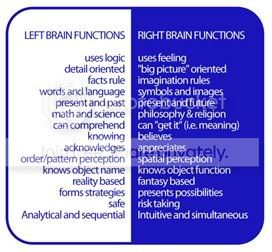
One is not better than the other. This only shows that there are different ways of thinking. Our personality is the product of the interaction between our left and right brain, and sometimes, product of non-interaction. Each of us draws upon specific sides of brains for both simple and complex decision-making that we do, depending on our age, education, culture, and life experiences.
This is not to say that right brain thinkers cannot learn the left brain activities and vice versa. It only says that for each activity or problem-solving, whether it’s a math equation, puzzle solving or painting, there’s an approach for a child wherein he can deal and learn more effectively depending on his natural inclination or which side of his brain is more dominant. For instance, a left brain-dominant child who has inclination on focusing first on details before getting the whole picture would learn to creatively paint an artwork if he/she is given the detailed tools and many options on techniques first instead of testing him/her to create out from pure imagination (which is natural and easier for right brain-dominant children). Furthermore, even if there is one side of our brain that is dominant, it doesn’t stop us from developing both. Each child can develop both sides of the brain provided that there are proper activities for a child to stimulate and develop his mind fully.
No doubt, schooling is more than enough to stimulate and develop the left brain of a child. In fact, study time to cover all basic subjects almost covers more than half of a child’s normal day. What happens to his right brain then as it stays dormant for an unnoticed length of time? What happens to the learning and development of a right-brain dominant child if he has to catch up learning via an approach that is not suitable for him? Worse, what happens to him if he has no time even to exercise and develop his right brain, his natural inclination?
Given these questions, there is indeed and underlying danger that some children might be deprived of proper approach and proper activities causing development to hamper and causing a lot of potentials to be dormant. Taking it from Psycho-Biologist Roger Sperry, “The main theme to emerge…is that there appear to be two modes of thinking – verbal and non-verbal, represented separately in left and right hemispheres respectively and that our education system, as well as science in general, tends to neglect the non-verbal form of intellect. What comes down to is that modern society discriminates against the right hemisphere.”
Our educational system with its emphasis on rote learning, places a higher value on left brain skills such as mathematics, logic and language than it does on creative thinking or using our imagination. School examinations are designed to test left brain activity and encourage conformity in thought. There is possibility that if right brain skills are not exercised, they may not develop sufficiently.
Just how important is developing the right brain is? To give emphasis on it, holistic thinking, experiential learning, dimensional consciousness, perceptive processing, creativity and resourcefulness are just among the few attitudes which if properly stimulated and developed, are drawn out from our right brain. While the left brain knows the concreteness of an object (e.g. name and origin), it’s the right brain that gives meaning and puts it into life (e.g. actual function). Thus it is very important that not only the left side of the brain must be developed but also the right side so that the average intelligence and creativity of mankind can be raised to a higher level. Activities must be included in the education system to tap and stimulate both left and right brain equally. Different teaching approaches must also be exercised to cater to different needs of each student (e.g. graphical illustrations in learning math or history to cater to right brain-dominant thinkers).
If we apply the training of left and right brain in formative years of a child, the process of development is being used in its full potential hence equipping the child with excellent thinking capability. Most of the time we process information using the prevailing side of the brain – it’s either the left or the right. But if we employ left and right brain strategies and let both participate in a balanced manner, the learning and thinking process is not just being enhanced but used in its full capacity thus creating a well rounded ability as early as the first stage of learning.

 Let your child develop and use his greatest asset in its FULL CAPACITY. It’s inside him, it’s the two hemispheres bestowed in him waiting to be honed. Do not let one part become active to the detriment of the other. Do not let the left brain be exhausted while the right brain is inadequately tapped. According to an International Coach and Trainer Mariliza Backstrom:
“Two brains are better than one.”
“If you double your brain power then you double your chances to have more success in your personal and professional life.”
“Get your brain in shape and double your success.”

One of the institutions that encourage right brain enrichment is Visual Art Education. Design Perception Visual Art Tutorial and Creative Studio offers various creative programs that allow students to engage in the process of creating themselves. It’s a setting wherein feelings, observation and imagination are being expressed and explored both by the creator and the observer. Our workshop employs proper, innovative and updated module/program. Creative activities are based on a more imaginative and genuine visual communication approach – the real thing of fine arts. It is a venue to let the right brain be nourished properly. Design Perception module developer and art educators are graduates and junior-senior of UP College of Fine Arts and other Art Universities who are in the visual work force such as advertising, graphic design, industrial design, fashion, photography, studio arts, animation, film production and more.
Offer your child a venue to develop and use his left and right brain and double his chance to have more success in school, future career and life. Let your child use his greatest asset in its FULL CAPACITY NOW!
This is an advertorial post by Design Perception Visual Art Tutorial Center.
 Design Perception Visual Art Tutorial and Creative Studio
(91) Nueve Uno Building, Xavierville Ave., Loyola Heights, Quezon City
Landline: (02) 545.7912Mobile No. 0906.3157.189
Email: designperception_visualarts@yahoo.com
Check and Like us on Facebook: Design Perception Visual Art Tutorial
No Comments »