Dog Bites and Rabies Infection
Last Sunday, we visited a family friend’s home for lunch to celebrate their village fiesta. What was an enjoyable afternoon though ended in a very unfortunate accident when the pet dog bit my son’s hand.
 We have actually started to say our goodbyes to end the pleasant visit when we were invited for a quick tour of our friend’s newly renovated home. Everyone joined the tour with the exception of my second son, who decided to stay on the ground floor. No one else saw how it happened. When we came down, my son approached our friend and told him that the dog bit his hand. He had already washed his hands and was quietly crying. Our friend washed the bite again and my husband proceeded to put antiseptic and bandaged it. We were told that the dog was up-to-date in all his shots. But still, our friend naturally felt guilty about the incident and was worried about our son. We said our goodbyes and told them we’ll bring our son to the hospital to have it checked. It was a good thing that it was a Sunday, and traffic was very light that we were able to bring the two other kids home and got to the hospital within an hour.
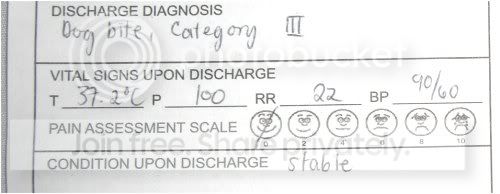
At the Emergency Room of The Medical City, the pediatrician on duty inspected the bite mark. Seeing that there were two small punctures, the bite mark was noted as Category III, (which I later learned is WHO’s standard in categorizing exposure to rabid animals) which meant my son had to take all the injections for rabies treatment, even if the dog was up-to-date in its shots. Rabies is a viral infection transmitted from animals to humans. Without immediate treatment, the victim may get the infection and once symptoms have set, the known treatment will not be effective.
For his immediate treatment, my son was injected with 2 vials of HRIG (Human Rabies Immune Globulin) on the area of the bite and on his thigh and a vial of the Intramuscular Immunization on his upper arm.
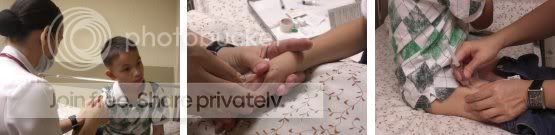
My son took all the injections with just a light wince. No complaints. He understood that he had to have the injections. I’m so proud of him.
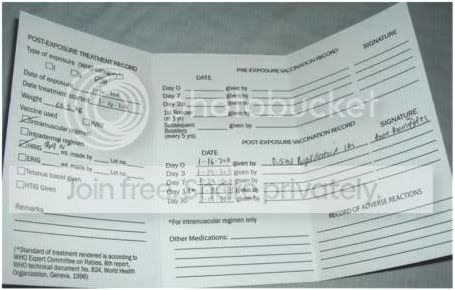
We were then given a card with the schedule of his next four Intramuscular vaccine shots. We were told that the schedule must be strictly followed, else we’ll have to start over.
My son took the news about the follow-up injections well. Thank God for his understanding of the treatment, for being brave and for his high tolerance of pain. He was discharged as stable with zero rating on the pain assessment scale.
The wincing that followed didn’t come from my son anymore… it was from me and my husband when the hospital bill came.

Well, thank God for my husband’s HMO plan who covered this treatment. The follow-up injections would not be covered anymore though, we were told. So, we’ll be buying the vaccine (VERORAB) at the drugstore (at half the price!) and have our doctor friend administer it to my son.
Here are the things I learned from this truly unfortunate experience:
1. Keep reminding the kids not to get close to other people’s pets. We have a pet dog of our own so maybe seeing our friend’s pet made them think that it’s okay to approach it like they do our own pet. My son said he didn’t pet/touch the dog, but he did call attention to it by saying hi and calling its name. The dog may have just been overly excited of seeing guests.
2. Keep our own pet away from guests. No matter how tame or well-trained our dog is, we would never know what goes in its mind. How they behave with house guests is unpredictable and it’s best just to have them away from our pet. Even if our pet is up-to-date in its immunizations, if in case biting occurs, the victim still must be brought to the doctor for check-up.
3. Be careful in handling our own pet. Rabies can be transmitted not just through animal bite but even through scratches and animal saliva coming in contact with open wounds.
4.Teach the kids what to do immediately after being bitten. My son was actually correct to immediately wash his hand. This is to wash off any remaining animal saliva. He was also correct in telling our friend (owner of the dog) immediately about it. From the look of the bite, it actually just looks like a wound and kids might just dismiss it as such, not knowing of the rabies infection.
Here are some useful resources about Rabies infection:
Fact Sheet on Rabies by the World Health Organization
http://www.who.int/mediacentre/factsheets/fs099/en/
Facts on Rabies by the Department of Health
http://www.doh.gov.ph/rabies/index.html
FAQ on Rabies by the Department of Health
http://www.doh.gov.ph/faq/show/451.html